Thursday, July 13, 2006

Mumbai 7-11 Blasts: "Govern or get out"

After the killing of 190 and injuring 650 people in Mumbai -- this the outcome of 8 highly targeted bombs on the Mumbai metro during rush hour, one wonders how much more should the citizens of India take?

The choice of Mumbai was not designed to unsettle the financial capital, but really meant to raise communal tensions between the Hindu majority and muslim minority. The riots in Gujarat are still not forgotten by the locals and lets now forget about the Mumbai blasts in 1993.

We don't need to look that far back, only last year Islamic terrorists bombed the holy Hindu city of Varanasi.

It beggars belief that India now has a Prime Minister who is completely at ease at talking about macroeconomic and how the diaspora can be unleashed across globe, but yet when slapped in the face countless times with blatant attacks on Indian sovereignty, can only meekly state:
"Do not be provoked by rumours. Do not let anyone divide us. Our strength lies in our unity."

Its time for India to step up and deal with these Al-Qaeda terrorists. Both Lashkar-e Tayyaba and Jaish-e-Mohammad are part of the terrorist infrastructure that has many sympathisers in Pakistan. This continued passive, tacit and turning a blind-eye support for terrorism must stop.

Opposition party, Advani, summarises it well about the situation for the Indian PM:
"Govern or get out".

On another sad note, still lingering from the tragedy of the Mumbai bombs, im surprised at the lack of news coverage from the British press, in comparison to the London and Madrid bombings. Picked politics, captures my sentiments more succinctly,
"clearly the death of nearly two hundred and injuries of thousands of wogs was not good enough for the Dail Mail, Daily Express or the Metro to make it front page news. Fuck them. "

This is a timley reminder, for me at least, of how important it is to continue blogging.

Monday, June 19, 2006

Time to move on....

first Robert Scoble, then Bill Gates, and now Om Malik.... all within the space of a week....

is there some kind of cartel or collusion hapenning, where everyone agrees to ditch in their job at the same time for maximum news exposure?

I guess Gateas has realised that curing Aids in Africa is more important than the next operating system. But, why-oh-why, did he not make that noble decision about 5-years ago? -- it would have been better for everyones sake!

Sunday, June 18, 2006

An inconvenient truth


i think its time to wake up, i think its time to realise that guzzling chevs' and over heated Google datacentres are a no-no...

Thursday, May 18, 2006

"How cool is that?"

I have an article featured at Deepak Chopra's blog.

My personal blog has become way too techy over the years... perhaps it will change now :)

thanks
Suresh.

Tuesday, January 10, 2006

Apple MacWorld 2006: Lets start taking bets.....

You can see Steve Jobs keynote at MacWorld 2006 here (from Tues 10ths Jan 9pm Pacific Time)

1. Replacement of the iPod Shuffle with a Nano variant? (e.g. Shuffle with screen or 1Gb Nano)
50% probability

2. Full length wide-screen iPod 6G
20% probability

3. Mac-Mini on Intel + Front Row 2.0
90% probability

4. iBook on Intel
100% probability

5. 42" and 50" iMac Intel + Front Row 2.0 (although possibly not branded as iMac)
SK: 80% probability

6. iTunes 7.0 + QuickTime 7.0 (its been a whole 6-months after all!)
SK: 60% probability

7. more video and tv and movie content on iTunes (including and we can only hope -- the full catalogue of Kylie Minogue and Britney Spears music videos).
SK: 100% probability (not sure on the later)

8. iLife/iWork '06 Updates (This is a given stable of MacWorld -- im informed by Jody)
100% probability

9. Aperture price reduction (to take the fight to Adobe)
50% probabilty

Wednesday, December 28, 2005

Mozilla Firefox 1.5 + Extensions

Over the last 2-months, ive been really getting into Firefox, ive found some quite useful extensions and scripts that extend the browser to my specific needs. For the hardcore browsers out there, download in the following order:

Firefox 1.5
The latest version of Firefox released in November 2005.
http://www.mozilla.com/firefox/

Google Toolbar for Firefox
The best way to surf and browse the internet.
http://toolbar.google.com/firefox/

Google Blogger Web comment for Firefox
A dynamic list of wesbites/comments that people have made about the current page that you are browsing. http://www.google.com/tools/firefox/webcomments/index.html

Tabs Session Saver
Re-opens previously running tabs before your browser was shut/closed.
https://addons.mozilla.org/extensions/moreinfo.php?id=436&application=firefox

Tabs Mix Plus
Provide a much detailed control of tab behaviour, a must for hardcore surfers.
https://addons.mozilla.org/extensions/moreinfo.php?id=1122&application=firefox

del.icio.us Toolbar for Firefox
A great way of tagging and bookmarking your favourite sites from any machine
(
A pity that Yahoo have bought them)
http://addons.mozilla.org/extensions/moreinfo.php?id=1532

Greasemonkey Script Manager
A javascript engine which enables developers to write simple scripts to manipulate your web pages.
https://addons.mozilla.org/extensions/moreinfo.php?application=firefox&category=Popular&numpg=10&id=748

Greasmonkey script(s)
Hundreds and hundreds of user developed Javascript plugins for Greasemonkey.
http://userscripts.org/

Update:
One other one to keep an eye out for is AllPeers, its a file sharing extension which uses one of the Peer Networks (possibly BitTorrent) -- its not available yet.
http://www.allpeers.com/more_f.htm

Wednesday, November 09, 2005

Ray Ozzie memo: Microsofts Services strategy

Dave Winer has posted 2 e-mail memos, from Bill Gates and Ray Ozzie, on the next step forward for the company.

Clearly Ray has had time to talk to the product teams, senior management and developers and has finally taken stock of the situation.

Ray Ozzie mentions some key tenents:

1. The power of the advertising-supported economic model.
2. The effectiveness of a new delivery and adoption model.
3. The demand for compelling, integrated user experiences that “just work”.

Fundamentally, Ray's
memo is a more than just a call to developers and product teams about service-enabling their assets. Its a an action-plan. Driven by end to end user-driven scenarios, something that Ray is very good at, from these use-cases, he will drive architectural design decisions and map that to current and fututure products/services.

I think this is not a good time for Microsoft, yet you can't but feel that finally they have someone at the top of Microsoft that actually gets it. What Mcirosoft has delivered as Ray has said is a 80% solution. In the post-"Vista/Office12" wave we will see a fantastic level of seamless integration of technology that weve not seen before, his past efforts with Notes and Groove should give us some inclination of the potential.

I have still some doubts though; Microsoft needs to balance Enterprise revenue models with Consumer/advertising revenue models. There needs to be harnomy between product and services -- the old mindset to lock-in services and products just won't cut it.

Wednesday, November 02, 2005

Windows "Live"

Fantastic! -- Reported by TechCrunch. Its Windows even when its not Windows! "Windows Live (beta)" is Microsofts go-to-market branding that will encompass its next geneartion SAAS (Software As a Service) strategy.

Its the harmonisation between Microsoft Windows, Microsoft Office applications, and Microsoft Services (Windows Live). We have seen this brand used in "Live" Meeting and XBOX "Live".

As Ray Ozzie mentioned here, the iPod and the Blackberry were "perfect examples" of how to create a tightly designed user experience from hardware, to software to services.

I think we will see a great example of that with the XBOX 360, a huge investment by Microsoft which goes beyond just gaming, it could easily become the centre-point for many of Microsofts other strategies around building tightly coupled hardware/software/services.

In terms of the announcements yesterday?
- early 90's - Microsofts energy was put into creating Windows "New Technology" (NT)
- mid 90's - Micorsofts energy was put into embedding Internet/Media experience into Windows.
- 2000's - Microsofts energy was put into .NET and Web Services strategy.

They stumbled a bit after that, and had this grand vision of connection people, devices, and services through "hailstorm".

The last 5 -years has been painful partly through trying to converge technologies streams into a big bang product roadmap, most of which will be released soon, .NET 2.0, Visual Studio 2005, Vista, SQL 2005.

But in the next 5-years, we'll see Microsoft tinkering less in that space, with putting more of a concerted effort on the User experience (not User Interface / not Product!) but my Identity, my Devices, my Work, my Perrsonalisation and my Events.

We will see a new abstraction of "the Windows API". It won't be Win32 or WinFX. But more likely WinLive Web Services API. All XML based contracts.

Ray Ozzie spent a long time talking about Ad Revenues being a $150bn industry by 2015. So wheres the lock-in? That bit is not clear. You'll still need Windows to truly use these Services. Microsoft needs to tread carefully here, but i suspect they are realising that lock-in through their software platform (to generate license revenues) isn't going to run in the long-term (not outside the Enterprise anyway), its going to be about converting users into revenue generating consumers for advertisers.

MSN used to be a place where Microsoft used to place executives before retirement. If i were to believe how Microsoft is positioning MSN against Windows Live, its clear to me one is designed for syndicated content (where current advertisers are at) and the other eventually will become the place for contextualised content (and where advertisers might go to in the future.)

Thursday, October 27, 2005

Google Base -- for a new Generation...

With all the multitude of ways of storing infromation, both structured and un-structured, we still dont seem fully liberated even when we store what is essentially simple data-sets, lists, hierarchically-structured information... on the Web.

Our information, like bookmarks, to-do lists, recently listening to music, wishlists, birthdays, calendars are all sitting on different peoples websites....

Google has realised that there are many companies (Web 2.0 style) that are offering just that... But in reality... there are only a couple of ways to skin a cat...

And whilst people are getting excited that
Google Base is supposed to kill e-bay, we just need to realise that there's just a bunch of journalists and Marketing research Analysts out just getting a bit excited.

Its not about killing e-bay. (far from it)

But it is about thinking about solving a problem implemented many times before, in a simple and easy way and (as Garret Rogets over at
ZDNET says...) about making money through search on this structured data.

Google wants to build a hosted database service, which relies on Google's highly scalable, fault-tolerant infrastructure, to provide an easy way for users to create their own data. That is searchable through its Search engine, that can provide targetted ads to subscribers of that data.

Think about it, you could expose that data, using RSS/Web Services (cos its SOA world out there), and you can then skin your own application using AJAX or Ruby on Rails...

Google has spent most of the last few years trying to organise the worlds data, most of which has been unstructured in web sites. Google is trying to find ways to organise structured information in a way that has never been done before. But also to unlock data held in websites which have been closed to Googles spider, in short this is a great monetization opportunity for advertisers who will be able to aggregate better quality information about subscribers.

And what we will be witnessing are the first steps of unleashing a new paradigm for building data-centric web applications.

Wednesday, October 19, 2005

OJOS: Collaborative Machine Intelligence

This is a company who has been getting a lot of attention from people. They have, in a very short space of time, acquired office space, developers, some very smart Computer Scientists and loads of VC money.

I think they have come up with an idea, which hasn't been thought about before and extends and builds on the principles of Web 2.0.

In short: Riya (formerly OJOS) = Flickr + Tagging + Human Learning + Visual Processing + AI = Automated Photo Tagging.

The software and Computer Science research to get computers to recognise a visual image has been improving in relation to the processing power available. Yet with all these advances nothing could bootstrap the machine learning process better than the ability for humans to 'teach' a computer on how to identify an image. This is where the collaborative tagging capability comes into play.

We have seen examples of where collaborative filtering to use the wisdom and knowledge of crowds to accurately determine whether an e-mail message is SPAM.

I think Riya is trying to take advantage of all the images that have been human "tagged" and correlate this with its own AI / Pattern Recognition engine.

In short... after the 1000th image of an iPod is uploaded on a blogger site or Flickr, Riya will have learned not only physical dimensional qualities about an image -- but also tagged data about it... -- Anyway thats my take on what these folks are up to...

Thursday, October 13, 2005

Y! Messenger & MSN Messenger

So... When the large Portal players (who in the past never gave a damn about interoperability) all of a sudden decide to play fair and interoperate. -- What are we supposed to think....?


Sunnyvale, CA, and Redmond, WA -- October 12, 2005 -- Yahoo! Inc. (NASDAQ:
YHOO - News) and Microsoft Corp. (NASDAQ:MSFT - News) today announced a landmark agreement to connect users of their consumer instant messaging (IM) services on a global basis. The industry’s first interoperability agreement between two distinct leading global consumer IM providers will give MSN® Messenger and Yahoo!® Messenger users the ability to interact with each other, forming what is expected to be the largest consumer IM community in the world, estimated to be more than 275 million strong.

That all of a sudden they give a damn about us? err no.
- More likely that Microsoft couldn't get the right deal with AOL.
- More likely that MSN and Yahoo! look at this pragmatically as a way keeping their respective registered users, rather than lose them.

As mentioned at Om Maliks Blog,
"Somehow with a move like that, and a potential AOL/MSN alliance it is starting to look like we will be having a three way dance between the Portal IM players [excluding AOL], Skype and Google."

Monday, October 10, 2005

"Indigo" for Linux

Paul Freemantle, a work associate back in the days... has now left IBM and has co-founded a new Web Services Infrastructure company called WSO2. -- "Oxygenating the Web Services platform".

No, this is not Web 2.0, its not AJAX, its not Google, its not about Ad Revenues! -- Its all about enterprise plumbing grunt that is supposed to miraculously work in the background.

Perhaps its harsh to use the term "Indigo for Linux" -- but im sure the world needs higher level frameworks than what is provided by WS-*.

In fact many of the founders of WSO2 helped contribute to many of the WS-* standards and Apache stacks. There purpose, they claim, is more ambitious than delivering "Indigo" for Linux, it is to build a Web Services platform "which treats Web services as first class components instead of as a facade to some existing platform like J2EE". Hmm... im a bit behind on whats going with Apache projects -- but is there a workflow/orchestration framework?

Check out more here on
Apache Axis 2 the follow up to Apache SOAP.

Sunday, October 09, 2005

The Self-Aware Universe

Not prone to plugging books....

But i have recently started reading this book... an interesting theory which for those with an understanding of Indian philosophy may recognise. The book drives straight into the field of quantum theory, human thought and the idea of universal consciousness..

Written by a Physics Professor, whose approach is scientific, he covers the subject of modern scientific thought and mathematics whilst blending in views on Spirituality, the Psychology of Religion, Philosophy, Life and God.

Oh and i have to admit from what Ive read to date, there's a lot i don't fully understand! But then again, the views of
Schrödinger, Heisenberg and Einstein weren't meant for the masses!

Tuesday, October 04, 2005

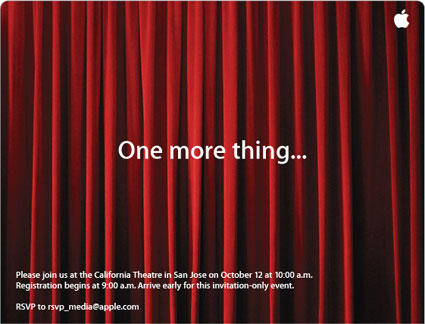
...one more thing

Dear Steve Jobs,

I pleae to you.

When you left us, we were angry. We thought you had sold us out, we thought you had gotten to arrogant for Apple.

But we knew better, the knives were out, and you left with your dignity held high.

And in those later barren days, you acted, you continued moving in places and areas with dreams that we could only just imagine.

We welcomed you back with open arms, and every year, we heard people say -- "as what is Jobs gonna pull out of the bag this year". And we listened and we watched, with patience, with a geek servitute unparalleled. We bought coke and sang the cool-aid.

The last 5-years, has been a roller-coaster ride hasn't it? Steve.

Like you did with Pixar and your grand vision with NEXT. You know where your heading...? Its just one big popcorn ride for us?

But you know what we want more... we don't want to live the dream... we want to be part of it.. we want to contribute... we want to tell you what works... what doesn't...


How Steve Jobs snookered the entire cell phone industry.... great article by Pill Palmer {Garage Insight) @ http://ipodgarage.com/article.php?id=386


Sunday, October 02, 2005

More on Web 2.0

On the eve of the Web 2.0 conference, Tim O'Reilly delves deeper here on what he means when he talks about Web 2.0 and how it is different to Web 1.0.

Let me try and use an example to make the point regarding Web 2.0, the company i work for this week sent an e-mail to everyone announcing the arrival of our new corporate Portal... realising that all the employees may not know what a 'Portal' is the e-mail continued with a suitable definition of the Portal, of it being a "gateway to your information" and further to that it would be like "My Yahoo" -- Woo! WTF?

Since when has My Yahoo been an authoritative gateway to my information and when has that been personalised to my interests. And here's the problems this so called Portal of ours (that they've spent millions on building). It is SO 1998. aka Web 1.0

Anyway, lets dive down into some of what Tim is saying, he covers a lot, and it really is worth going through it.
Web 1.0 Web 2.0
DoubleClick --> Google AdSense
Ofoto --> Flickr
Akamai --> BitTorrent
mp3.com --> Napster
Britannica Online --> Wikipedia
personal websites --> Blogging
evite --> upcoming.org and EVDB
page views --> cost per click
screen scraping --> web services
publishing --> participation
directories --> tagging ("folksonomy")
stickiness --> syndication

He admits that there is a danger of this becoming very gimmicky with companies marketing similiar types of applications without really understanding the essence of what makes these companies or styles unique. For that let us understand in more detail the essential principles that appear to make Web 2.0 different to Web 1.0

The web as a platform can be highlighted with several examples,

"Google vs. Netscape -- If Netscape was the standard bearer for Web 1.0, Google is most certainly the standard bearer for Web 2.0, if only because their respective IPOs were defining events for each era. So let's start with a comparison of these two companies and their
positioning.
"


In many ways, within the context of Web 2.0, Netscape is much closer to say a Microsoft or an Oracle or a SAP or a Lotus. For the reason being that even though Netscpae was different than those others in the same category, they were essentially about selling software products, and their business model was tied to selling shrink-wrapped software products to the Enterprise. Google living out in the internet -- builds software services, with frequent updates, its business model is not at all tied to the enterprise.
"Double Click vs' Google Adsense and Yahoo Overture -- Like Google, DoubleClick is a true child of the internet era. It harnesses software as a service, has a core competency in data management, and, as noted above, was a pioneer in web services long before web services even had a name. However, DoubleClick was ultimately limited by its business model. It bought into the '90s notion that the web was about publishing, not participation; that advertisers, not consumers, ought to call the shots; that size mattered, and that the internet was increasingly being dominated by the top websites as measured by MediaMetrix and other web ad scoring companies. "

Here again we see the differences, subtle, but yet powerfully change the game. DoubleClick believed that the advertiser should be in control and had the power to determine who to advertise to, they falsely focused on the 20% of the largest sites, ignoring the long-tail 80%. Google worked out how to create advertising space to even the smallest website -- in short it scaled downwards as well as upwards, scooping up revenues across the board and with the added benefit of targeting relevant ads.

"Akami vs. BitTorrent -- Like DoubleClick, Akamai is optimized
to do business with the head, not the tail, with the center, not the edges.
While it serves the benefit of the individuals at the edge of the web by
smoothing their access to the high-demand sites at the center, it collects its
revenue from those central sites. "


BitTorrent does treat the Web as a Platform.... but it treats the software as a platform only when its highly connected. That is it relies on the principle of network effects.

"BitTorrent thus demonstrates a key Web 2.0 principle: the service automatically gets better the more people use it. "

Collective Intelligence

"Hyperlinking is the foundation of the web. As users add new content, and new sites, it is bound in to the structure of the web by other users discovering the content and linking to it. Much as synapses form in the brain, with associations becoming stronger through repetition or intensity, the web of connections grows organically as an output of the collective activity of all web users."

I really like what Tim is saying here, who hasn't wondered whether this constant chatter of ideas, drivel, thoughts isn't in some way being modelled and represented digitally through blogs and the internet... are we in the process of discovering meta-models for a global consciousness?

His further examples of Yahoo (with its re-focus on providing a personal content platform for the individual), Google (due respects to the incremental improvements achieved through page ranking -- the inclusion of human opinion in the page ranking weightings), ebay (whose ability to direct buyers and sellers better through the critical mass it has created in its network), Amazon ( who understands the science of user engagement and the ability to generate use interacts flows around the product its sales --? related products -- wish-lists -- Listmania! -- people who bought this also bought....)

Added to this he talks about other companies/services that are harness the network effect of services; Wikipedia (the complete global democratisation of content and information; -- the last bastion of hope to preserve THE truth); Flickr/del.icio.us (sites that have created collaborative communities through users being able to label pictures and sites based on keywords -- often referred to as labels or "tags" -- this created unusually divergent clusters of communities that may not have been at first obviously identifiable); Cloudmark (Collaborative spam filtering -- no need to have complex software algorithms to determine if something is spam, use a global rating system determined by humans!);

Debatably, Tim says that :

"You can almost make the case that if a site or product relies on advertising to get the word out, it isn't Web 2.0."

I am of course troubled with this, since it reeks of exclusivity, and there is nothing wrong with advertising or marketing something like Orkut, GMail (being opposite examples of this exclusivity), however behind that remark is an important principle, and that reaching a critical mass of collaboration is key to the success of a Web 2.0 application, whilst advertising can help, maintaining such a critical mass is altogether a different ball game (look at friendster today).

"The lesson: Network effects from user contributions are the key to market dominance in the Web 2.0 era."
END of the Software Release Cycle

When Mark Lucovsky (former distinguished engineer at Microsoft NOW working for Google)
said:

I am not sure I believe anymore, that Microsoft "knows how to ship software".

He was of course talking about his frustrations at Microsoft's inability to deploy innovative products out there in a timely fashion... but really this is another important principle that is differentiated with Web 2.0

As i had mentioned
previously, there are key competencies that Web 2.0 company needs to understand that means building a services-oriented operational organisation

"It's no accident that Google's system administration, networking, and load balancing techniques are perhaps even more closely guarded secrets than their search algorithms. Google's success at automating these processes is a key part of their cost advantage over competitors."

Its a 24-7 operation, not just keeping a site up, but listening to users, responding to users, implementing changes. Microsoft has done an exceptional job to reaching out to users, people like Robert Scoble have brought Microsoft into our living rooms.... but you know what? so what if they heard us back in 2003 at the PDC, Microsoft's business model is still built around selling shrink-wrapped software to large enterprises -- listening to users is only one part of it, the second is the rapid ability to respond and deploy that feedback..
Real time monitoring of user behavior to see just which new features are used, and how they are used, thus becomes another required core competency. A web developer at a major online service remarked: "We put up two or three new features on some part of the site every day, and if users don't adopt them, we take them down. If they like them, we roll them out to the entire
site."


Lightweight programming models
A discussion close to my heart... We all know whats going on in the WS-* world... and we know that people in the da big house also know whats going on with WWF and Indigo. We all know one day WS-*/WWF will make our lives easy.

Yet what has clearly defined Web 2.0 has been quite the opposite of all that enterprise wire-gook which we know is important (but which has become confusing as hell due to corporates and standard bodies)

In Summary, as mentioned by
Julian Bond
-
REST / [POX] not XMLRPC, XMLRPC not SOAP, SOAP, not WS*
- RSS , not custom XML schema, Simple XML schema not obfuscated RDF
"This same quest for simplicity can be seen in other "organic" web services. Google's recent release of Google Maps is a case in point. Google Maps' simple AJAX (JavaScript and XML) interface was quickly decrypted by hackers, who then proceeded to remix the data into new services."

Of course the problem with AJAX, is that every f***ing company and product under the sun will become 'AJAX-compliant'. But likewise that does not make it 'Web 2.0'.

Software above the level of a device

Hardware (devices/users) --> Software (devices/PC) --> Services (Internet) --> Content (creators)

In this category there are very few babies that can really claim this, but there are many that would like to compete in this space. Back in the 70's in a very limited way IBM had this with its control of the Software/Operating system and Hardware. And even Microsoft during the 80's/90's managed this to a considerable extent with its OS/API/IBM compatible PCs.

But nothing quite as powerful as demonstrated by the digital distribution ecosystem that Apple has created with iTunes, iTunes Music Store and the iPod. There are many aspects that Apple i think needs to work on (user feedback, rapid improvements to its products/services), but with the recent addition of a Podcasting network, we are seeing the dynamics of this platform changing by enpowering content creators... So whilst today this may be Podcasters.... tomorrow that could become an environment for a new generation of music artists to bypass the music labels.

"To date, iTunes is the best exemplar of this principle. This application seamlessly reaches from the handheld device to a massive web back-end, with the PC acting as a local cache and control station. There have been many previous attempts to bring web content to portable devices, but the iPod/iTunes combination is one of the first such applications designed from the ground up to span multiple devices. TiVo is another good example."

Rich User Experience
No discussion on Web 2.0 and rich user-experience would be complete with a 2.0 discussion on web interface.

We know whats happening with AJAX, and the world can thank Google for Google Mail and Google Maps for showing us this....

But it won't end here, Microsoft with XAML, its declarative HTML-esque language for creating rich-user interfaces that can be deployed on the Window Vista (Windows Presentation Framework) run-time and companies like Laszlo systems (who are building a similar declarative development environment which can generate DHTML and Flash applications) are also having a say on things.

These latter examples, are laudable efforts, buts lets remember the tenet, lowest-common-denominator, i don't think XAML/WPF run-times will become available for Linux or OS X so it makes hard to build those Web 2.0 style services if you limit your audience.